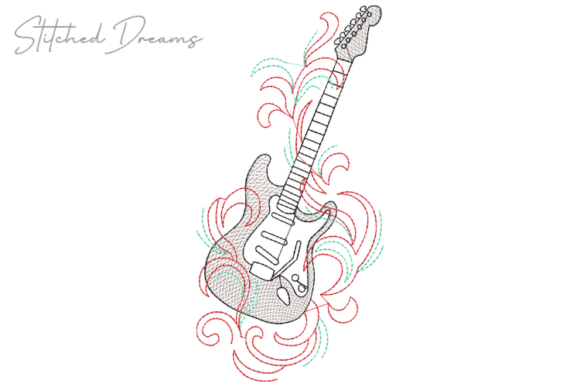
Guitar Embroidery Design
A Practical Review for Small Business Merch & Branded Patches
As an embroidery designer who’s digitized and stitched thousands of commercial projects—from café aprons to boutique tote bags—I approached the Guitar Embroidery Design with a specific question: Does this work as functional brand identity—not just decoration? For small business owners, craft studios, Etsy sellers, and local shops, embroidery isn’t about “pretty stitching.” It’s about consistency, durability, recognition, and trust. Let’s break down how the Guitar Embroidery Design holds up across real-world applications.
First Impression: Friendly, Creative, and Professionally Balanced
Based on its title and description—“Add a musical touch… beautifully detailed guitar”—the Guitar Embroidery Design signals approachability and creative energy. It reads as friendly, not overly technical or sterile; handmade, but not amateurish; and musical without leaning into cliché (no cartoon notes or exaggerated flames). That balance matters. A florist adding it to linen aprons conveys artistry—not noise. A pet brand using it on bandana tags hints at personality without misalignment. It avoids looking too “music-store generic,” which helps small businesses stand out in saturated markets like handmade goods or local retail.
Where It Shines in Business Use
- Embroidered patches: Ideal for sew-on or iron-on application on tote bags, jackets, and staff vests. Its central silhouette offers strong legibility even at 2.5”–3” width—critical for patch-based branding.
- Apron embroidery: Works cleanly on chest or pocket placement. The guitar’s horizontal orientation aligns naturally with apron seams and avoids visual crowding near waist ties.
- Cap embroidery: Performs well on front panels when scaled to ~2” height. The design’s clean outer shape minimizes distortion on curved surfaces—especially important for structured caps used by cafes or studios.
- Tote bag design: Scales beautifully to 4”–5” on cotton canvas or canvas-blend totes. Its visual weight anchors the bag without overwhelming hand-stitched or printed text nearby.
- Staff uniforms & work shirts: Functions as a subtle chest logo accent—more distinctive than a monogram, less busy than full-sleeve graphics. Builds cohesion across teams without sacrificing professionalism.
- Product packaging accents: When stitched onto fabric labels, twill tags, or reusable pouches, it reinforces handmade product value—especially for vinyl shops, indie record stores, or craft supply brands.
- Etsy branding & customer gifts: As a small embroidered detail on thank-you pouches or limited-run merch bundles, it adds tactile authenticity that digital logos can’t replicate.
Where Caution Is Needed
The Guitar Embroidery Design is versatile—but not universal. Use discretion in these scenarios:
- Small patch sizes under 2”: Fine details (like string separation or fret markers) may blur or “fill in” during stitching. Always test at target size before bulk production.
- Dark uniforms or textured fabric: High stitch density in shaded areas could cause puckering on fleece, terry cloth, or heavy twill. Confirm stabilizer type matches fabric texture—and consider simplifying thread colors for contrast.
- Frequent washing or high-friction items: If the design includes delicate outlines or tight interior fills, reinforce with proper underlay and test wash durability—especially for aprons or staff shirts.
- Curved cap fronts or tapered sleeves: While the guitar’s shape adapts well, avoid placing fine linear elements (e.g., thin neck lines) directly over seam allowances or extreme curves where registration shifts.
- Commercial embroidery projects with strict brand guidelines: Compare the Guitar Embroidery Design beside your existing design assets. Does its line weight, spacing, and rhythm match your logo system? Inconsistency weakens brand identity—even with great embroidery.
How It Strengthens Brand Identity & Customer Trust
For small businesses, every embroidered detail communicates intention. The Guitar Embroidery Design doesn’t scream “music store”—it whispers “creative care.” That subtlety builds trust: customers recognize craftsmanship, not clip art. When stitched on a bakery’s linen apron or a florist’s canvas tote, it signals thoughtfulness—not trend-chasing. It elevates perceived product value because embroidery inherently reads as higher effort and investment than print. And unlike digital graphics, it survives wear, washing, and time—making it ideal for repeat-use merchandise that represents your brand long after launch.
Essential Designer Notes Before Production
Before ordering or digitizing further, run these checks:
- Test the Guitar Embroidery Design in black-and-white first—this reveals contrast issues and hidden density traps.
- Verify it scales cleanly to your smallest intended use (e.g., 1.75” patch)—check for collapsed details or unintended fill merging.
- Review thread color contrast against your base fabric—especially for dark garments or textured materials.
- Inspect spacing between elements: Are strings distinct? Is there breathing room around the body outline? Tight spacing increases stitch density and risk of shifting.
- Confirm hoop size compatibility with your machine and frame setup—don’t assume standard 4x4 fits if the design extends beyond typical boundaries.
- Test on actual fabric—not just stabilizer swatches—with your intended needle, thread, and tension settings.
- Create a printable mockup for client approval *before* stitching. Visual alignment matters more than specs on paper.
- Compare it alongside other design assets—logo, typography, icons—to ensure visual harmony across your branded patch, apparel, and packaging.
- Confirm commercial licensing applies to your use case—especially for resale, wholesale, or multi-location rollout. A digital embroidery file isn’t automatically cleared for unlimited business use.
The Guitar Embroidery Design delivers what small businesses need most: flexibility without compromise. It’s not just a music-themed graphic—it’s a smart, scalable piece of brand infrastructure. Whether you’re launching custom apparel for a creative studio or adding embroidered distinction to your handmade product line, this design earns its place—not as decoration, but as deliberate, durable identity.